ML Research Engineer

Physics-Informed
Structure-Aware
ML Systems

Physicist-turned-ML engineer specializing in systems where domain structure matters — time-series, anomaly detection, and generative modeling with physical constraints.

15+
Years of
Research
€1.3M+
Competitive
Funding
50k+
Technical
Impressions
Suchita Kulkarni

About

I work at the intersection of physics and machine learning, building systems where domain knowledge isn't decorative but structurally load-bearing. My background spans theoretical particle physics, scientific software development, and applied ML across industry-relevant problems.

Previously I led interdisciplinary research teams across Austria, France, and Germany; managed €1.3M+ in competitive funding; and built SMoldeS, a widely adopted Python toolkit for new-physics searches at the LHC. I now focus on uncertainty-aware prediction, physics-constrained generative models, and agentic ML systems.

Two principles shape how I approach ML. First, structural priors: domain knowledge (physics equations, biochemical constraints, cost models) embedded directly into architecture, where it shapes behaviour rather than just regularising it. Second, scientific rigour: proper baselines, calibrated uncertainty, and evaluation that produces an explanation for why a result happened, not just that it did.

I co-organise the Women in AI, Austria Styrian meetups and a regular speaker at applied ML meetups and international workshops.

15+
Years spanning experimental physics and applied ML
€1.3M+
Competitive funding managed across EU research programs
50+
Researchers coordinated for the Snowmass Dark Showers report
100+
New-physics searches covered in the SModelS v2 codebase

Experience

2025 – Present
ML Research Engineer
Graz, Austria
  • Physics-informed ML for time-series, anomaly detection, and generative modeling
  • Built agentic ML systems with hallucination-constrained LLM reasoning pipelines
  • Public technical writing reaching 50k+ impressions across a 10-part series
  • Regular invited speaker at applied ML meetups and international workshops
2011 – present
Postdoctoral Researcher — Particle Physics & ML
Austria · France · Germany
  • Lead architect of SModelS v2 — widely adopted Python toolkit covering 100+ LHC new-physics searches
  • Managed €1.3M+ in competitive EU research funding across interdisciplinary teams
  • Coordinated 50+ researchers for the Snowmass 2021 Dark Showers community report
  • Long-lived particle searches at the LHC; influenced experimental parameter choices
2007 – 2011
PhD — Particle Physics
Europe
  • Computational high-energy physics: Python-based simulation, analysis, and visualization
  • Foundational training in statistical modeling, Bayesian inference, and large-scale dataset analysis

Tech Stack

ML & Deep Learning
PyTorch scikit-learn XGBoost Optuna HDBSCAN
Data & Scientific
pandas NumPy SciPy Biopython SModelS
LLM & NLP
OpenAI API Ollama sentence-transformers
Deployment & Viz
Streamlit Matplotlib Seaborn GitHub Pages

Selected Projects

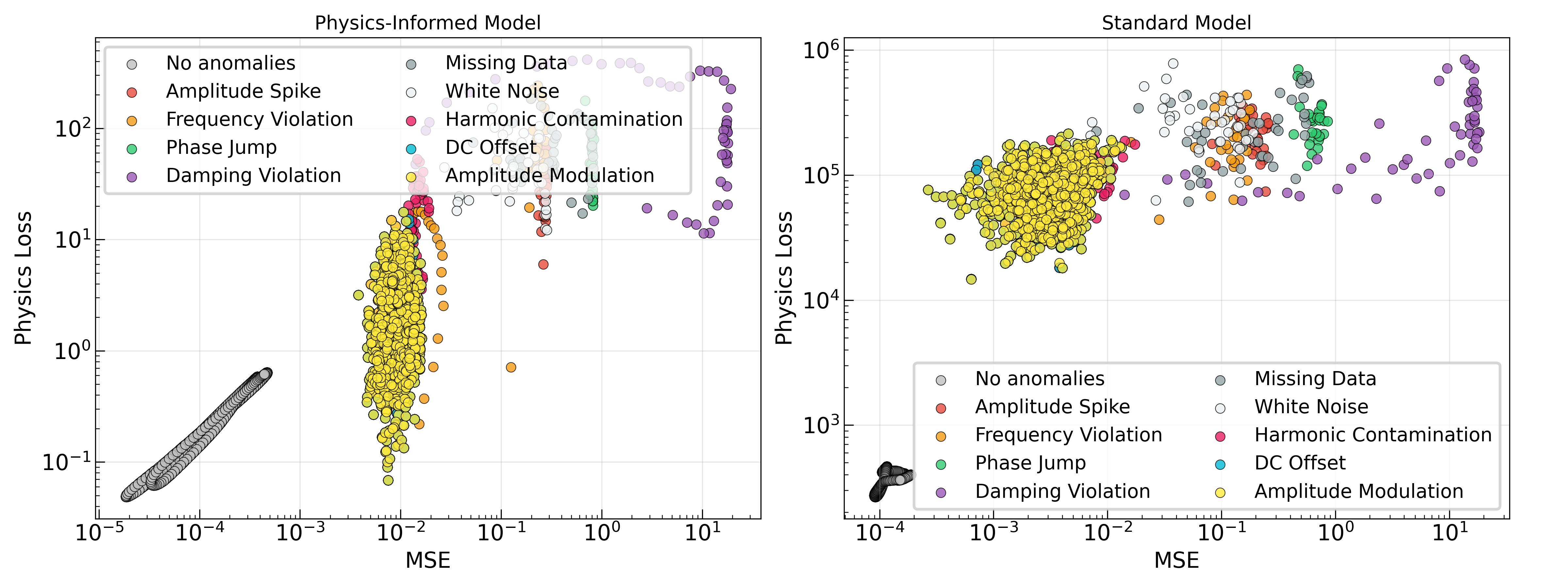
2D diagnostic landscape: physics-informed vs standard LSTM
Physics-Aware LSTM for Anomaly Classification
77% detection rate 61% classification accuracy ARI 0.42 vs 0.31

2D diagnostic landscape combining reconstruction and physics loss to classify 9 anomaly types without labeled anomalies. Physics-informed kNN outperforms standard baseline by 21 pp on detection rate. Decision framework documented in a 10-part public series reaching 50k+ impressions.
PyTorch scikit-learn NumPy Streamlit
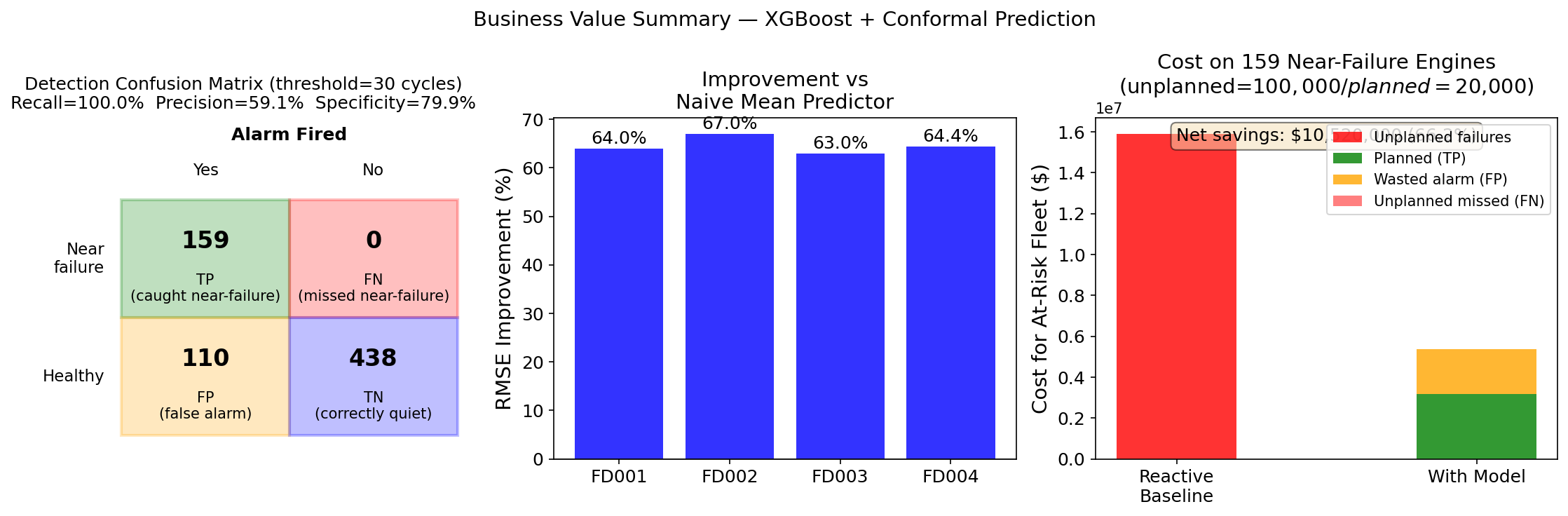
RUL prediction business impact summary
Remaining Useful Life Prediction — NASA Turbofan
RMSE 14–16 (↓ from 18–20) >50% maintenance cost reduction

Physics-grounded feature engineering — condition-normalized sensors (KMeans, 6 clusters), rolling statistics, monotone RUL constraint — combined with XGBoost + Optuna tuning. Uncertainty via split conformal prediction (90% coverage). Evaluated on cost-based metrics across all 4 CMAPSS datasets.

XGBoost Optuna scikit-learn pandas Streamlit
Ramachandran compliance: physics VAE vs standard VAE
Ramachandran Physics-Informed VAE
0.82 Lovell compliance Cohen's d = 0.905 All 3 islands recovered

Standard VAE collapses to 1D on imbalanced protein data; a differentiable PyTorch GMM penalty recovers all three Ramachandran islands. Latent perturbation across 6 sigma levels confirms 100% win rate in phi stability. Dataset: 1,333–3,335 samples from 5 structurally diverse PDB proteins.

PyTorch Biopython scikit-learn Streamlit
Agentic music recommender Streamlit app
Agentic Framework for Music Analysis & Recommendation
153 songs · 5 musical eras Hallucination-free LLM

Constrained LLM reasoning architecture that grounds every recommendation in structured audio features — prevents hallucination while preserving human-readable explanations. Hybrid system combining Spotify audio features with semantic topic modeling (HDBSCAN). Explainability is a first-class design requirement, not a post-hoc label.

Ollama OpenAI HDBSCAN sentence-transformers PyTorch Streamlit

Talks & Community

Writing

Technical Series · 50k+ impressions

End-to-end technical walkthrough of building a physics-informed LSTM for anomaly classification: architecture choices, the 2D diagnostic loss landscape, and evaluation across 9 anomaly types.

Read on LinkedIn
PM Perspective

What the anomaly detection project looks like from a product angle: the decisions made, what the performance improvement actually means operationally, and how physics constraints change the conversation about model trust.

Read on LinkedIn
Creative ML

Behind the scenes of creating an AI-generated theme song for TEDxGraz: the process, the tools, and what building something creative with ML teaches about its actual capabilities and limits.

Read on LinkedIn

Selected Publications

Python-based simulation and visualization for search optimization. Influenced parameter choices and experimental search strategies.
Coordinated 50+ researchers across theory and experiment. Shaped field-level synthesis and research directions.
Lead architect of Python codebase covering 100+ new-physics searches. Accelerated interpretation of collider constraints on dark matter models.

Get in Touch

Open to collaborations, speaking invitations, and research or industry roles in ML and physics-informed systems.